Written by an eSIM site · the router wins three times
eSIM or pocket wifi in Japan?
Japan is the one country where renting a wifi router is still a serious answer. We priced both, and there are three situations where we would carry the box.
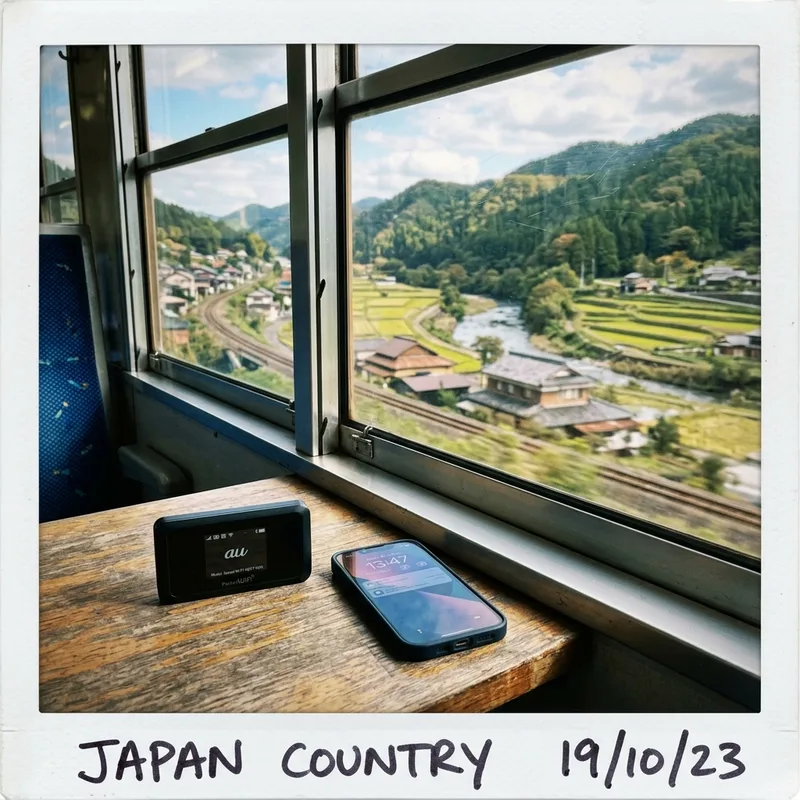
Why this question exists in Japan and almost nowhere else context
Pocket wifi died as a travel product almost everywhere. In Japan it did not, and the reason is historical rather than technical.
Japan built a rental wifi industry in the years when foreign SIMs were awkward, tourist voice SIMs were legally restricted and unlimited domestic data was cheap. That industry has counters at every major airport, a hotel delivery network, and enough scale to keep prices low. It did not go away when eSIMs arrived; it just stopped being the default.
So unlike Greece or Vietnam, where "should I rent a router" has a one-word answer, Japan genuinely has a case on both sides. The case depends almost entirely on how many people are travelling with you.
What each one actually costs for a week real rate cards, not headline rates
| Seven days in Japan | Cost | What you get |
|---|---|---|
| Pocket wifi, mainstream renter | ≈¥6,300 (≈$42) | Unlimited-ish data shared across up to five devices, plus a device to carry, charge and return. |
| Saily 20GB / 30 days | $24.99 | Twenty gigabytes on your own phone, no hardware, no return. |
| GigSky 10GB / 30 days | $16.79 | Ten gigabytes on NTT Docomo. Enough for a week of maps, messaging and photos. |
| Airalo unlimited / 5 days | $17.00 | 3GB a day at full speed then 1 Mbps. The closest eSIM equivalent to a router. |
| Saily unlimited / 7 days | $28.99 | 5GB a day at full speed. Still $13 under the router, for one person. |
| Airport tourist SIM counter | ¥3,000–5,000 ($20–34) | 8 to 30 days of data, and since April 2026, a passport scan. Details here. |
Yen converted at roughly ¥150 to the dollar. Pocket wifi figure is seven days at Japan Wireless's published ¥900 daily unlimited rate for short rentals, before any deposit, insurance option or late-return fee. eSIM prices in USD, checked September 4, 2026.
The turning point is three people. One router at $42 split three ways is $14 each, which beats every eSIM on the page. Split two ways it is $21 each, which is roughly a wash against GigSky's 10GB and worse than it if you only need ten gigabytes. For one person it is not close.
The three cases where we would rent the router and we sell eSIMs
This is the real case and it is not marginal. One router covers up to five devices on one bill. At about $42 for a week split three ways you are paying $14 a head for shared unlimited data, and no eSIM on this site gets close to that. A family of four is paying $10.50 each.
Older handsets, most Japanese-market phones, some carrier-locked US devices and almost every work phone with a management profile. Dial *#06#: if no EID appears, an eSIM is not an option and the choice is a router or a physical SIM. The SIM route is here.
Streaming several hours a day, a laptop tethered for full working days, uploading photo or video work every night. Every Japan "unlimited" eSIM is a daily allowance of 2 to 5GB. A rental router's unlimited plan is closer to actually unlimited, and if you are the person who will find the ceiling, you will find it on day two.
Maps, LINE, train apps, translation, photos and a couple of hours of video a day is 10 to 15GB over two weeks. That is $24.99 from Saily for the whole trip and nothing to carry, charge or return. This is most visitors.
Airport rental counters keep hours. Returns are a desk you have to find with a suitcase and a flight time. A 06:50 departure from Haneda is exactly when the return counter becomes a real problem, and an eSIM has no return counter.
The router goes with one person. The other person has no data. Couples who spend a day apart discover this at the moment they need to find each other in Shinjuku station, which is the largest railway station in the world by passenger numbers.
What the router costs you that the rate card does not mention five things
A second battery to manage. A pocket wifi router runs six to ten hours and dies faster in cold weather and on 5G. You are now charging two devices every night and carrying a power bank for the router as well as the phone. On a fourteen-hour sightseeing day it will be the router that goes flat.
A deposit and a liability. Most renters take a deposit or card authorisation and charge for loss or damage, typically tens of thousands of yen for a lost unit. A phone you already insure; a rented box in a coat pocket on the last train you do not.
A return you have to schedule. Airport drop box, post office or courier envelope, and a late return is billed by the day. This is genuinely fine if you plan it and genuinely annoying if you are running for a Narita Express.
One connection, one group. Everyone tethered to the router has to stay near the router. This is a small constraint that becomes a large one the first day somebody wants to go to a different museum.
"Unlimited" that is not. Rental routers run on Japanese carrier plans with their own fair use terms, and heavy users report throttling after a few gigabytes in a day on some plans. The difference from an eSIM is that the eSIM tells you the number in advance. Every eSIM cap in one table.
The third option nobody frames properly both
These are not exclusive. The cheapest sensible setup for a group is one router plus one small eSIM for whoever is most likely to wander off, which costs $2.99 from GigSky for a gigabyte over a week and removes the single worst failure mode of the router.
The other combination worth knowing: GigSky's free 100MB costs nothing and expires on its own, so install it before you fly regardless of what else you do. It is a working phone at immigration and a fallback on the evening the router battery dies.
Whatever you decide about the router, there is no reason not to land with a working phone. GigSky's trial is 100MB for seven days with no card, and it is the only free plan in this comparison.
Get the free 100MB See every eSIM planeSIM vs pocket wifi questions short answers
Is eSIM or pocket WiFi better in Japan?
For one or two people, an eSIM: a week of pocket wifi is about ¥6,300 or $42 against $24.99 for a 20GB eSIM, with no device to carry, charge or return. For three or more sharing, the router is cheaper per head and there is no daily cap. It also wins if your phone cannot take an eSIM or if you are a genuinely heavy daily user.
Do you really need pocket WiFi in Japan?
No. It was close to essential ten years ago, when foreign SIMs were awkward and tourist SIMs were legally restricted, and it is now one option among three. Most visitors are better served by an eSIM installed at home before the flight. The exceptions are groups, incompatible phones and very heavy users.
How much does pocket WiFi cost in Japan per day?
Advertised rates start around ¥440 a day, but that assumes a 30-day rental. On a real seven-day trip expect roughly ¥900 a day for an unlimited plan from a mainstream renter, dropping to about ¥800 between eight and fourteen days and ¥700 beyond. Ninja WiFi lists ¥1,980 a day with tax for its unlimited plan before promotions. Always price your actual dates.
Is pocket WiFi unlimited in Japan?
Mostly, and with fair use terms behind it. Rental routers run on Japanese carrier plans, and heavy users report throttling after several gigabytes in a day on some of them. It is still less restrictive than any travel eSIM, all of which cap daily data between 2GB and 5GB.
Can several people share one eSIM in Japan?
Yes, by hotspotting from the phone that holds it, and none of the brands we link charges extra for that. What you cannot do is put one eSIM on several phones. For a group, either one person hotspots for everyone, which flattens that person's battery, or you rent a router.
One or two people? $24.99 beats $42
Twenty gigabytes over thirty days from Saily, on your own phone, with nothing to collect at the airport and nothing to return. If there are three of you, rent the router, and we will not earn a cent from that.
See Saily Japan plansSources & freshness: Pocket wifi rates from Japan Wireless and Ninja WiFi published rate cards and 2026 price guides, converted at roughly ¥150 to the dollar; deposits, insurance options and late fees vary by renter and are not included. eSIM prices from esimdb and each brand's Japan page on September 4, 2026, in USD. Airport tourist SIM prices from 2026 counter listings at Narita and Kansai. We earn a commission on eSIM links and nothing on router rentals. How we test.